Focus mode
One keystroke hides both rails and dims the chrome until you reach for it. Just the page.
A serious writing studio with a living world beside it.
Draft novels, build books chapter by chapter, write screenplays in industry format, and storyboard scenes in your world's own art style. Your lore stays in the margin, and your cast answers in its own voice when you ask what a character would do.
No card required. Your first document is free.
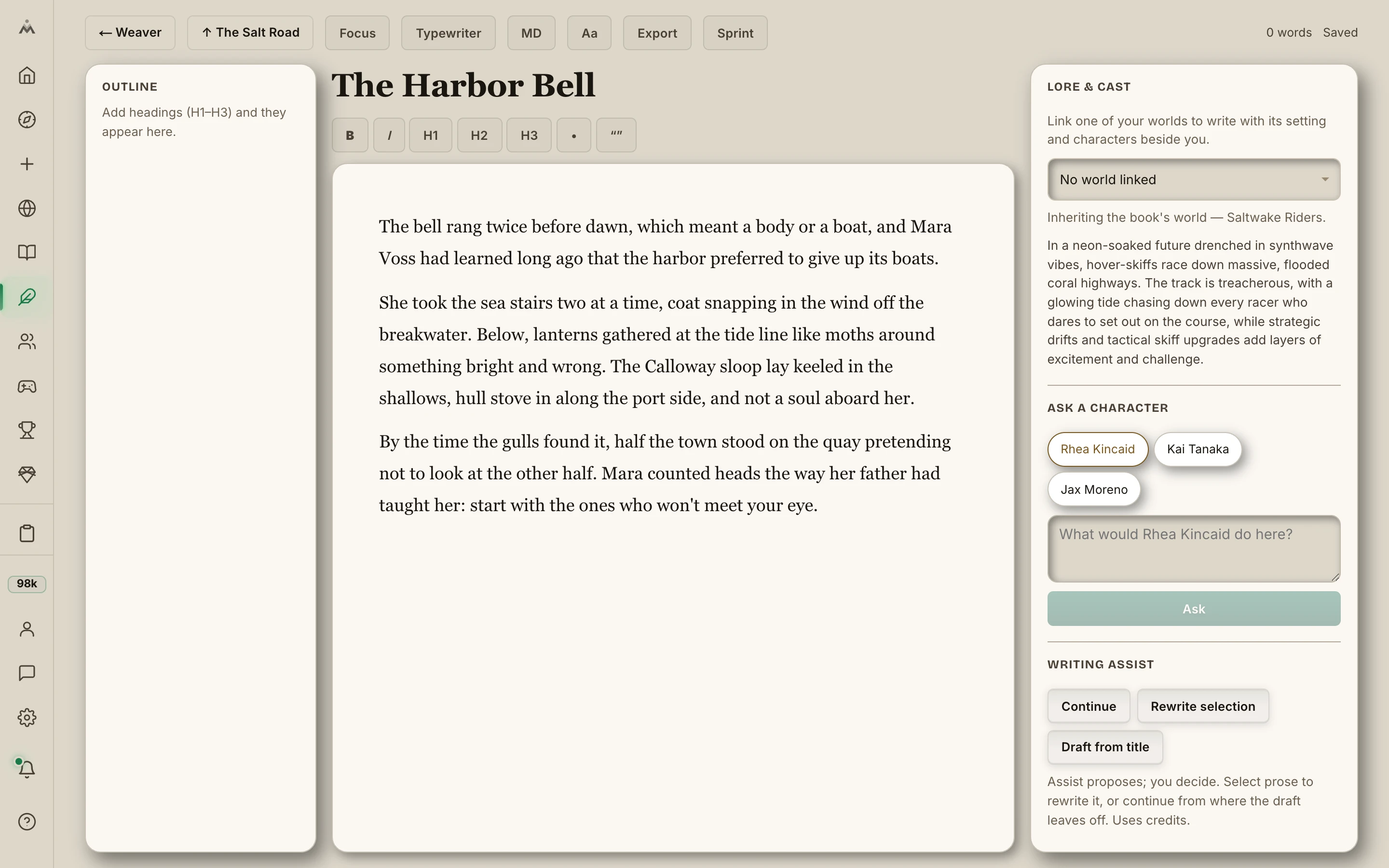
Send assist a verb: continue, rewrite, expand, condense, or draft, from the rail, the selection toolbar, or the slash menu. The result lands in a proposal card, never in your manuscript. Accept it, retry it, or throw it away.
Tone presets steer the voice: tighter, lusher, darker, lighter, a custom note, or simply match my prose. Nothing touches the page until you say so.
The harbor bell rang twice and stopped, the way it never did. Maren counted the silence the way other people counted coins.
Link one of your wilds.ai worlds and the studio stops being empty software. The setting sits in the margin, the cast answers questions in their own voices, and storyboard panels paint in the world's established art style.
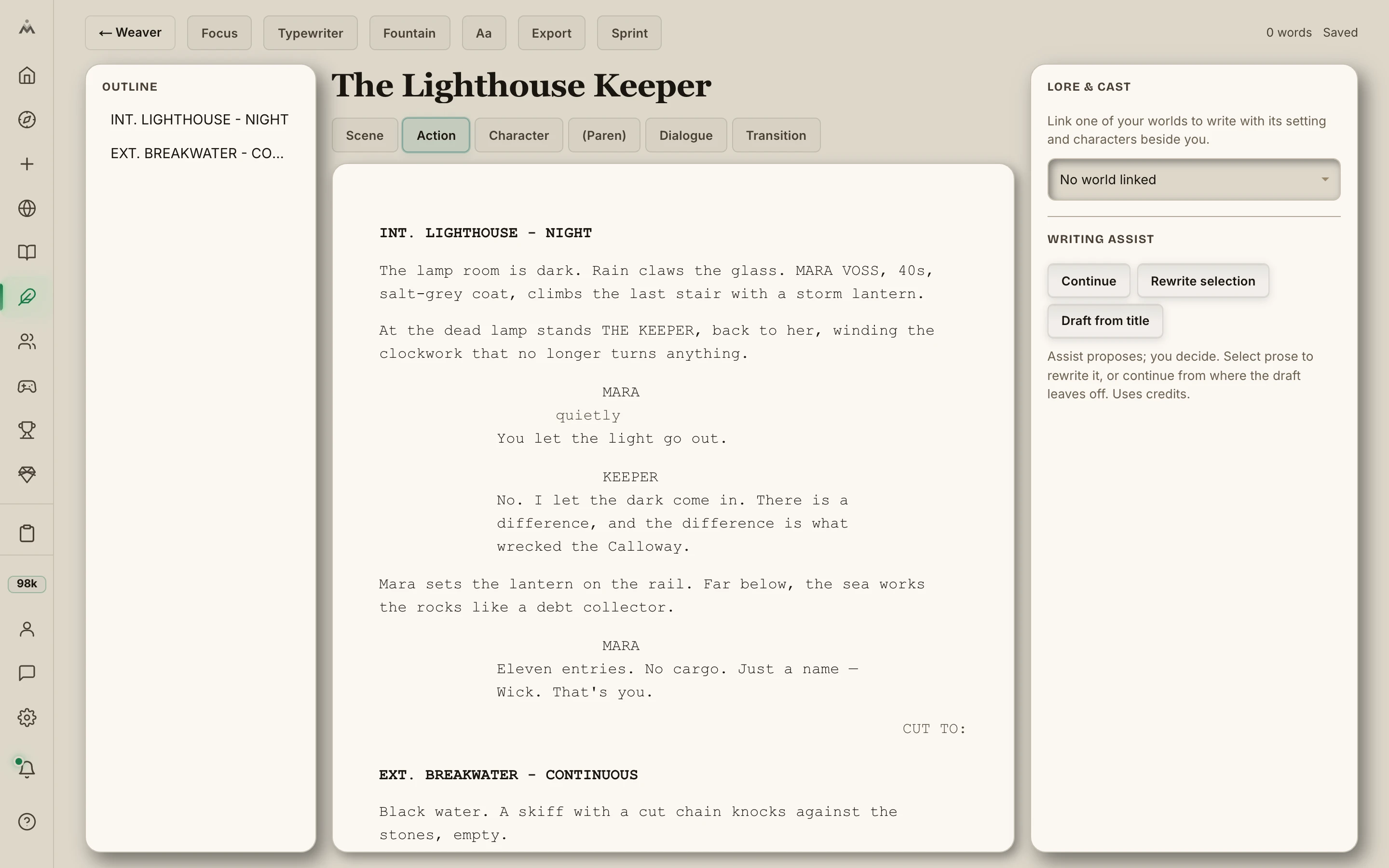
Books hold chapters; chapters are full documents. Reorder them, write each one at the complete desk, and compile the whole book to a single manuscript whenever you want to see it as a reader will, Markdown on every plan, print-ready PDF on Plus.
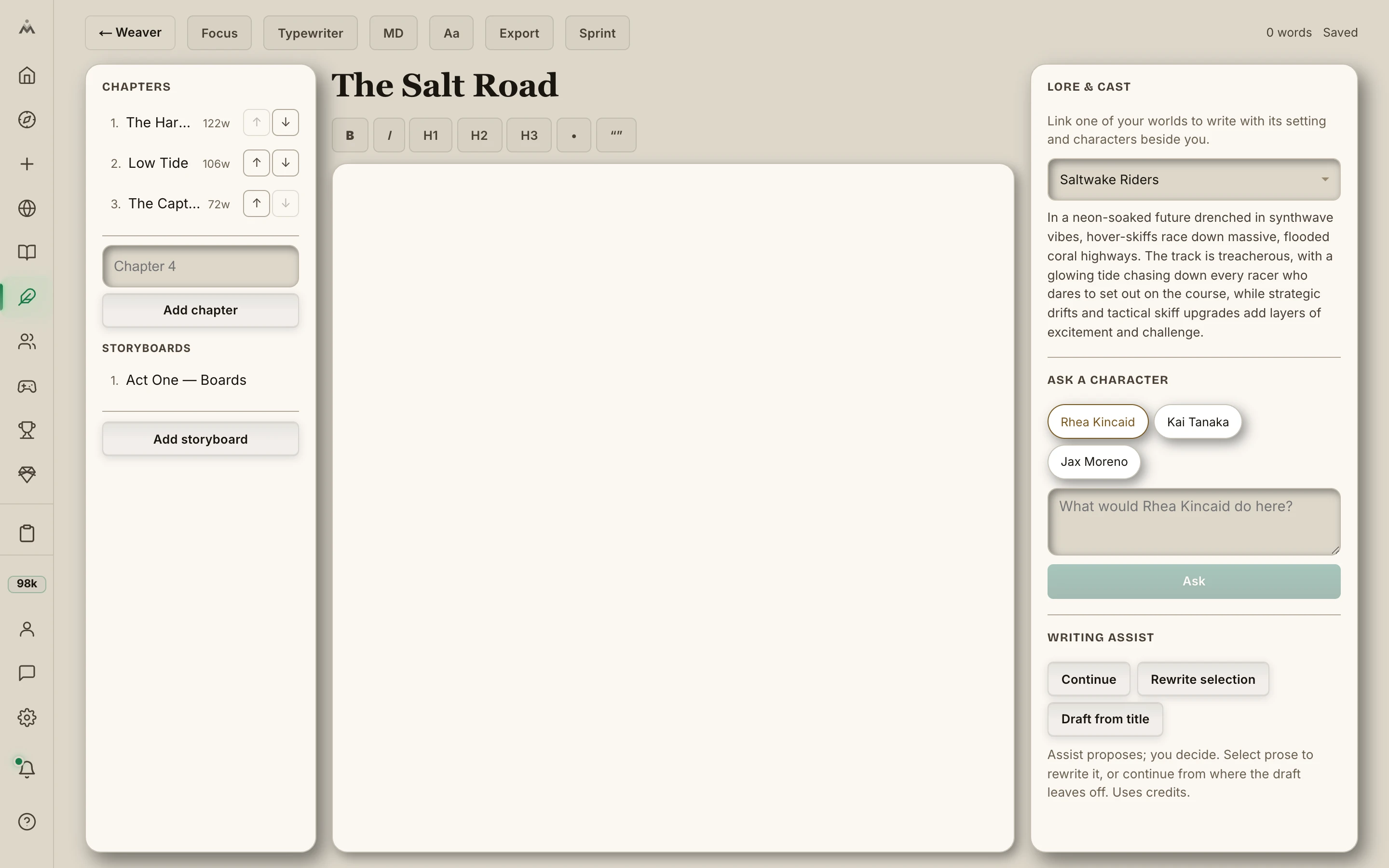
Tab cycles the element, Enter advances it: scene to action, character to dialogue, the muscle memory of a dedicated screenwriting app. Export the open Fountain format, or print a US-letter, Courier 12 PDF ready for the table read.
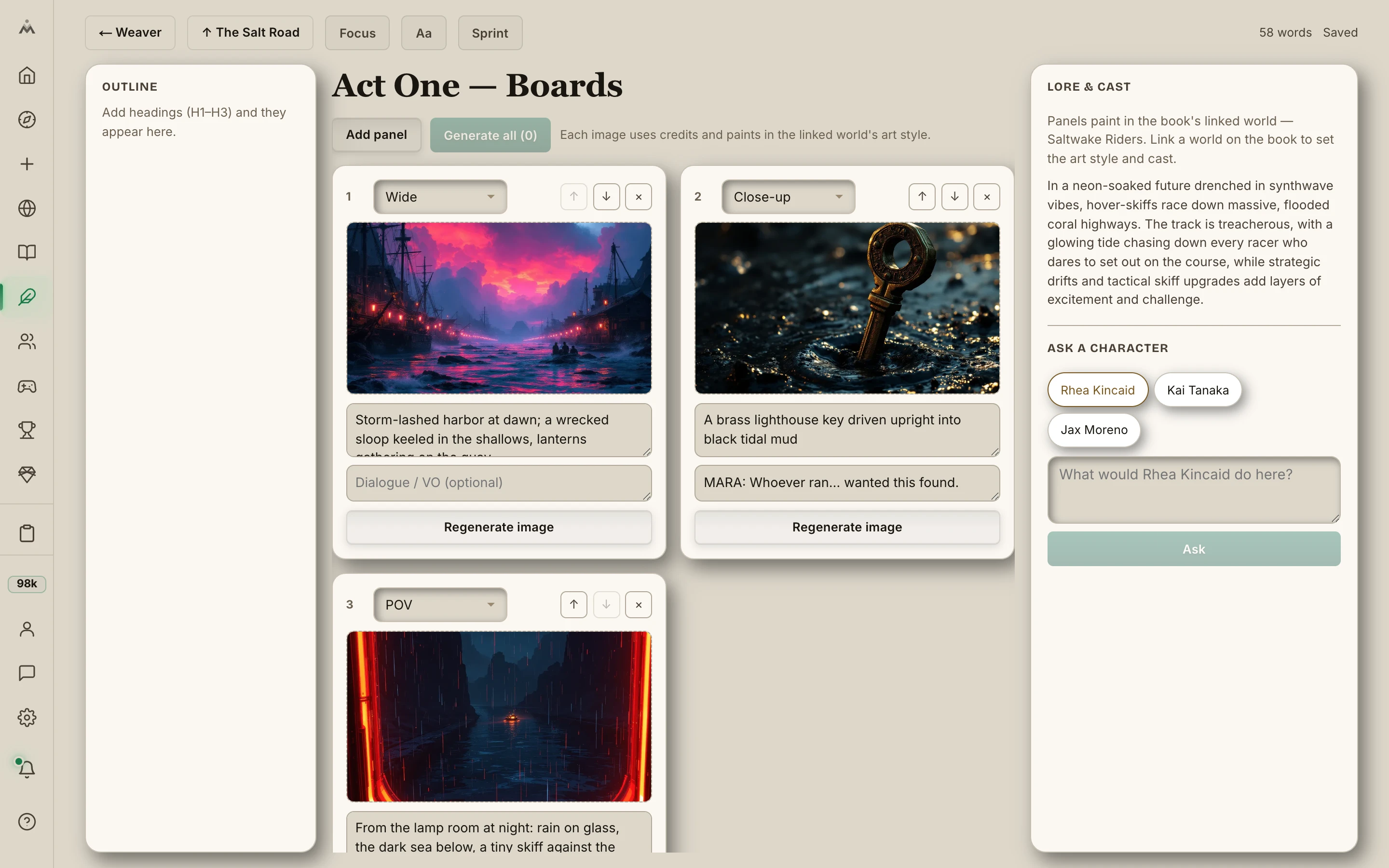
Boards attach to a book and hold panels: shot type, caption, dialogue. Generate art for one panel or hit Generate alland watch the board fill in, painted in the linked world's art style so every frame matches your story.
The storyboard surface grows into full pages: panel layouts, speech balloons and lettering, and art painted in your world's established style, spread by spread. Storyboards work today and are the natural place to start blocking your story.
One keystroke hides both rails and dims the chrome until you reach for it. Just the page.
The caret stays centered and the active paragraph is spotlit while the rest recedes.
Serif, sans, or mono. Narrow, normal, or wide measure. Sepia paper if the night runs long.
Set a word goal per document, run a 10, 20, or 45 minute sprint, watch the meter fill.
Words, characters, reading time, page estimate, selection counts, and your session total.
Flip any document to Markdown source, or Fountain for screenplays, and edit either side.
Weaver is part of wilds.ai, not a separate subscription. The desk is open to every account, and AI features (assist, character answers, panel art) spend the same credits your games run on. Paid wilds.ai plans add monthly credits, unlimited documents, books, screenplays, storyboards, and PDF export; credit packs work without a subscription.
Open a draft, a book, a screenplay, a storyboard, an outline, or a note. The desk autosaves from the first word.
Attach one of your worlds and its setting, regions, and characters appear beside the manuscript. Chapters inherit the book’s world automatically.
Write with the outline at your left and the cast at your right. Ask a character what they would do, or send assist a verb and judge its proposal.
Compile a book to Markdown, print a manuscript or screenplay to PDF, export Fountain or plain text. It leaves the studio in the format the next step needs.
A clean WYSIWYG editor with a live outline beside it, autosaved as you type, with focus and typewriter modes built in.
Continue, rewrite, expand, condense, or draft. Every result lands in a card you accept, retry, or discard.
A book is a binder: chapters you can add, reorder, and write at full size, compiled to one manuscript on demand.
Scene headings, cues, parentheticals, dialogue, and transitions with Tab-cycle and Enter-advance.
Block out shots with captions and dialogue, then generate art per panel or for the whole board.
Your cast sits beside the draft. Ask any character what they would do and they answer in their own voice.
The linked world’s setting and cast stay in the margin. No tab-switching to remember the harbor district.
One keystroke opens every action and every document. Slash commands drop blocks without leaving the keys.
Markdown, plain text, and Fountain on every plan. Manuscript, book, screenplay, and board PDFs on Plus.
Search, sort, and filter the hub. Duplicate a draft, move it into a book, or pick up the three most recent.
Set a word-count goal, run a timed sprint, and watch the session meter fill while statistics stay one click away.
The same account, the same worlds, the same cast. Write the lore in Weaver; the world is one click away.
Weaver is the writing studio on wilds.ai: a WYSIWYG editor with a live outline for drafts, outlines, and notes, plus books with chapter binders, screenplays, and storyboards. Link one of your worlds and its setting, lore, and characters sit beside the manuscript; ask any character what they would do and they answer in their own voice.
No. Weaver is included with every wilds.ai account; there is no separate writing subscription. Free accounts get one document with the entire desk, and AI features spend the same credits your games run on. A paid wilds.ai plan unlocks unlimited documents, books with chapters, screenplays, storyboards, and every PDF export, and adds monthly credits. Credit packs work without a subscription.
Yes. A book document is a binder: add chapters, reorder them, and write each one at the full desk. Compile exports the entire book to one manuscript, as Markdown on every plan or as a print-ready PDF on Plus.
Screenplay documents use industry-standard formatting: scene headings, action, character cues, parentheticals, dialogue, and transitions, cycled with Tab and advanced with Enter the way dedicated screenwriting apps do. Export to the open Fountain format on any plan, or print a US-letter, Courier 12 PDF on Plus.
A storyboard is a grid of panels attached to a book: each panel has a shot type, a caption, and dialogue. Generate art for one panel or the whole board; panels paint in the linked world’s art style so the board matches your story’s look.
With you, and only on your signal. Every generation lands in a proposal card with Accept, Retry, and Discard; nothing touches the manuscript until you accept. Tone presets steer the voice, from tighter to lusher to darker, or match your own prose. Every word is yours to keep, change, or cut.
Yes. Weaver documents are private to your account. There is no public feed and nothing is published; the only way words leave the studio is when you export them.
Coming soon. Graphic novels grow out of the storyboard surface: panel layouts, speech balloons and lettering, and pages painted in your world’s art style. Storyboards already work today and are the best place to start blocking your story.
No. Weaver is a long-form writing desk for prose, scripts, and boards. Interactive fiction (Twine, ink, classic parser games) has its own dedicated Story Studio on wilds.ai.
Open the studio, link a world, and write the first paragraph tonight. Your first document is free.
Telling stories in code instead? That's the Story Studio: Interactive fiction → · Twine → · ink →