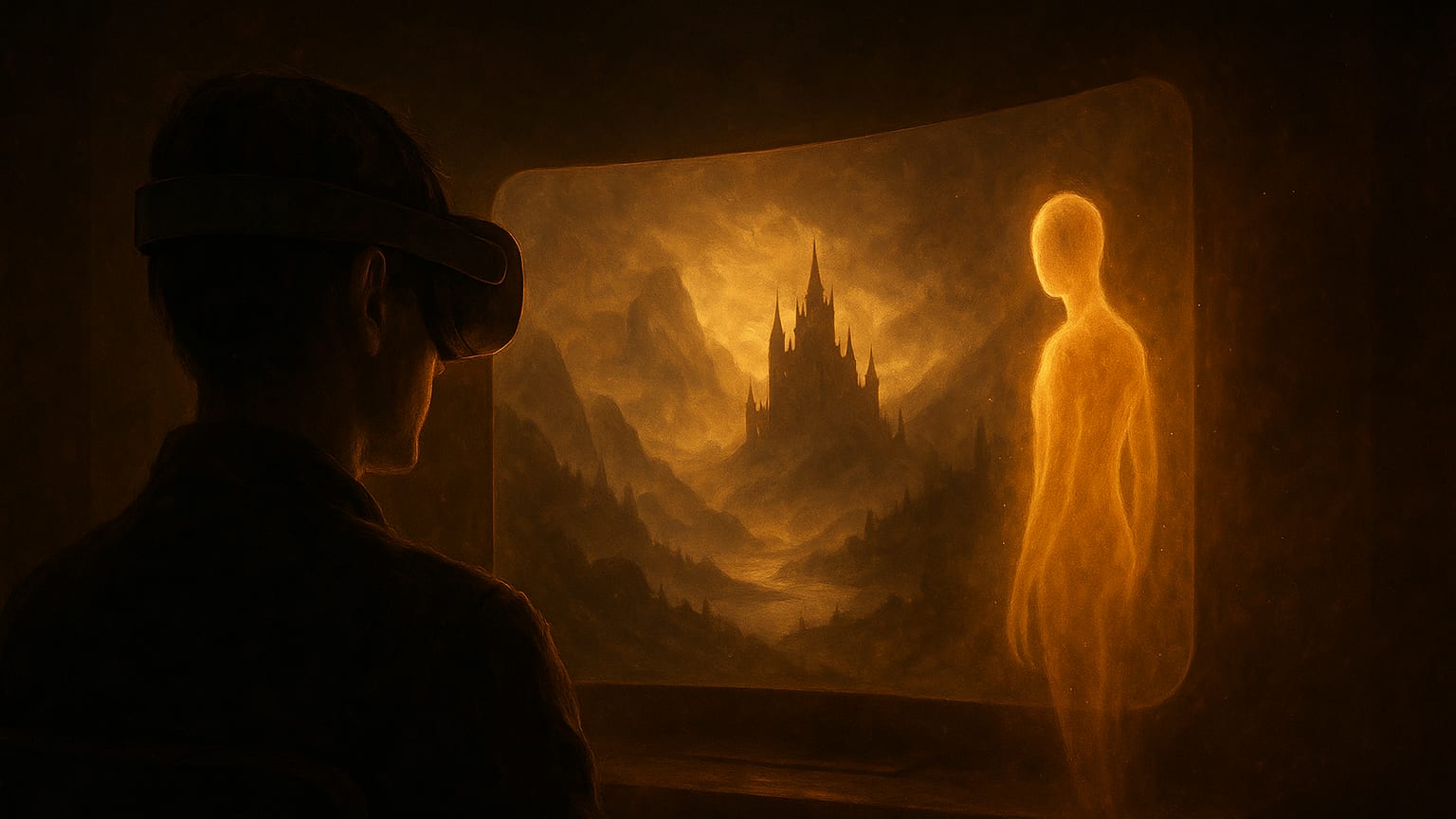
wilds.ai goes VR — every world ships to a headset, no re-authoring
"The Metaverse is a fictional structure… but it's also a place." — Neal Stephenson, Snow Crash
Every metaverse pitch for thirty years built the world first and bolted the intelligence on afterward. We did it backwards. The memory, the characters, the deterministic engines were already running on web, iOS, and Android against one session API — so the headset is just the fourth browser we point them at. Today every existing blueprint can enter a WebXR session on Quest 3, Quest Pro, Quest 2, Vision Pro, Valve Index, Pico 4, or anything that speaks the WebXR Device API. Nobody re-authors a thing.
Creators do not republish. The shell decides what each headset can render natively, what it should mirror on a curved cinema screen, and what to fall back to flat. A single capability probe answers the question for the session before the loader runs.
Three tracks, one publish
Every wilds.ai game family picks one of three tracks for a headset session.
Native stereo. Realtime-3D worlds drop straight into a 6DoF scene. The dungeon engine, the cinematic cameras (chase, combat, door transition, death), the boss phases, the per-class loadouts, the status effects, the healer beams — all of it runs in stereo with the same engine that runs in a flat tab. Board-game sessions get the same treatment for tactile pieces in front of the player.
Curved cinema. Narrative, visual novel, crawler, and TTRPG sessions paint to a 1.8m-wide curved screen 1.5m in front of the seated player. The AI character floats beside the screen as a stylized portrait — same persona, same memory, same mood model. Opt-in VRM 1.0 avatars use Meshy, Tripo3D, or Hunyuan3D to generate full-body 3D versions of the character that share the same HEXACO traits and the same conversation history.
Curved DOM panel. Arcade, platformer, roguelike, survival, strategy-sim, and point-and-click sessions project their canvas onto a curved DOM panel via the Drei HTML portal. The same React engine that runs in a tab also runs in a headset, with the WebXR camera mounted to the panel center so the player can lean in or back off.
The track decision is made per session by a single capability gate. A Quest 3 with both controllers active gets native stereo for realtime-3D, curved cinema for narrative, and a curved DOM panel for arcade. A headset that loses tracking falls back to flat without losing the session. Players never see the negotiation.
Comfort gates that ship on by default
Every native and curved session ships with the comfort gates the WebXR community has spent five years tuning.
- Locomotion: teleport with floor raycast, smooth move with adjustable speed, snap turn at the player's preferred angle.
- Comfort: motion vignette during smooth move, sitting mode that anchors the origin so room-scale players who switch to a chair do not have to recenter, restore-origin shortcut for any drift.
- Input: 6DoF controllers, hand tracking with gesture classifier, ray cursor for distant interaction, wrist menu that follows the player's pose without taking over the field of view.
- Haptics: the same
useHapticshook the touch and gamepad layers already use, threaded through to the controller's vibration actuator.
The defaults are set per family. Realtime-3D combat opens with teleport + snap turn. Cinema narrative opens with sitting mode + smooth-move disabled. Creators override per blueprint, players override per session, persona-level defaults override both.
Characters, in your room
The character presence is the part we are proudest of. Every wilds.ai account already has characters with HEXACO personalities, infinite cognitive memory, mood that shifts every turn, and trust that builds across hundreds of conversations. The VR shell adds two new presentation modes.
Portrait mode is the default for the ~100 existing blueprints. The character floats beside the cinema screen as a stylized portrait that reacts to mood shifts and dialogue cues. No 3D asset generation, no per-character authoring, no setup. Every existing character gets a portrait the day the headset connects.
Avatar mode is opt-in per character. Creators (or the character's owner, for personal characters) trigger a one-shot 3D character generation against Meshy, Tripo3D, or Hunyuan3D. The result is a VRM 1.0 humanoid that drops into the scene with the character's appearance descriptor as the prompt seed. The avatar inherits every cognitive trait of the portrait version — same memory, same mood, same trust state — and adds full-body presence for the moments when sitting across from someone matters more than reading their face.
Both modes route through the same orchestrator. A character that started as a portrait can be upgraded to an avatar mid-conversation without losing a single turn of context.
Devices supported today
| Headset | Native 3D | Curved cinema | Hand tracking |
|---|---|---|---|
| Quest 3 / Quest Pro | yes | yes | yes |
| Quest 2 | yes | yes | yes |
| Apple Vision Pro | yes | yes | partial (eye + pinch) |
| Valve Index | yes | yes | controllers only |
| Pico 4 | yes | yes | yes |
| HTC Vive | yes | yes | controllers only |
| Any WebXR browser | depends on device | yes | depends on device |
Cross-device matrix lives on /vr with the live capability snapshot and the per-family track decision.
Why VR matters for an AI game platform
The pitch is simple: the AI is already there. Memory, voice, characters, deterministic engines — all of it already runs. VR is the surface where a player can sit across from the character they have been talking to for six months and have the conversation feel like a conversation. It is the surface where a dungeon you generated from a one-line prompt becomes a place you walked through. It is the surface where the cinema mode for visual novel sessions stops being a screen and starts being a room you share with a story.
We are not building a VR game engine. We are extending a game engine that already shipped to every browser and every phone, so that the next browser the player opens is the one inside a headset. The metaverse has been waiting for the AI layer. The AI layer was waiting for the runtime that could deliver it consistently across every device.
Both are here now.
What's next
The shell ships in beta. The capability probe, the curved panels, the cinema screen, the comfort gates, the locomotion, the hand tracking, the character portraits — all live. Native realtime-3D is live. Cinema mode for narrative + visual novel + crawler is live. DOM panel projection for arcade + platformer + roguelike is live.
What's next on the roadmap: multiplayer presence in shared sessions (sit in the same cinema room as a friend, watching the same narrator stream), full-body inverse kinematics for avatar characters, spatial audio anchored to character position, and the controller binding editor that lets players remap any semantic action to any gamepad / hand-gesture / controller input.
Open /vr for the full architecture walkthrough. Open /the-wilds for how VR fits into the shared metaverse roadmap. Or open any world you already have in your library and look for the "Enter VR" pill on the play lobby — it lights up the moment a supported headset connects to the page.
Welcome to wilds.ai in stereo.