AI Playtesting: How Our Agents Test Games
Our AI playtesting at wilds.ai starts with a written brief and 30 turns. A language-model player takes on a persona, such as a speedrunner or a player who tries odd inputs, and plays one of our games through the same session API the site uses. After every move, code compares the game's state before and after the move with the narration. It flags broken rules, such as a health bar that swings 50 points with no wound in the story. When a test confirms a defect, we fix the system that made it, such as the engine a whole family of games shares. The worked example near the end follows one game, Drug Wars: 1984, from researched players to fixes checked on the live site.
What is AI playtesting?
AI playtesting is testing a game by letting AI players play it and report what broke, turn by turn. Automated playtesting is the wider term for any software player. It covers a studio bot that replays recorded inputs and compares a screenshot with the expected one [1], and Unity's "Virtual Player", which "emulates the input of a real player" [2].
Researchers call players built to act like particular kinds of people "procedural personas" [3]. At wilds.ai we test three ways:
- An API playtester. Language-model players with personas play live sessions turn by turn while code checks the rules on the game state.
- Browser tests. An AI agent and a set of scripted suites play through the real screens at phone and desktop sizes.
- A test rig for AI-created games. It builds fresh games, drives them in a browser with scripted inputs and has AI judges grade them.
Can AI playtest a game?
Yes, for finding what breaks. AI players reach crashes, frozen turns, broken rules and endings nobody can reach, and log the turn where each one happened. Whether a game is fun stays a question for people. Studios and researchers report results like these:
| Who | How the agents play | Reported scale or result |
|---|---|---|
| Capcom, 2026 | Agents "look at the screen like a human" | "30,000+ hours of autonomous playtesting per month" [4] |
| King, Candy Crush Saga, 2019 | A bot screenshots each new screen and maps it into a graph | Traversed "+4500 levels" [5] |
| Unity Game Simulation, 2020 | Virtual players emulate a real player's input | Nearly 40,000 hours of playtesting across three studios [2] |
| TITAN research, 2025 | Language-model agents play two commercial MMORPGs | 95% task completion and four previously unknown bugs [6] |
One r/gamedev reply puts the doubt plainly: "Its pretty hard to build an automated test that actually plays the game and logs unexpected behaviours unless the game is pretty simple" [1]. Our answer is rule checks on every turn and, for AI-created games, verifier agents that try to refute each serious group of findings.
How does an AI playtest run on wilds.ai?
One run is one persona playing one game against the live site, for up to 30 turns by default:
- Open like a player. The run fetches the game's summary and cast, creates a real session, and plays the opening narration first, so the cold open is tested too.
- Show the scene. Each turn the persona gets the game state (cut to 4,000 characters), the last four narration passages, the latest recap, its own last five notes and the actions the scene allows.
- Take a move. The persona answers in fixed JSON: free text, one of the scene's written choices, or an action such as buy, sell, travel, rest, use or equip. It adds one line on what it is testing, and the runner feeds those notes back on later turns.
- Play and check. The runner posts the move, reads the state again and runs six rule checks on the before and after states and the narration.
- Keep it honest. A persona that repeats its last move is asked for something different. An earlier version skipped repeats, and on 12 September 2026 a run that spent three turns recorded one. A request that fails on a server or network error gets up to four tries. A turn the server is writing gets up to 30 checks, 5 seconds apart; live turns have taken up to about 118 seconds. Three failed turns in a row abort the run.
- Refresh memory. Every 12 turns the runner asks the game for a recap and hands it to the persona.
- Write it up. The run finishes at an ending, a game over, the persona's choice to quit or the turn budget. It writes a JSON log, a readable transcript and a model-written review in six parts, from Impression to Recommendations.
A sweep multiplies games by personas by runs. Every sweep marks a game FAIL when none of its runs reaches an ending, so a long sweep shows which games none of its runs could finish. Our five-turn preset sweep answers a narrower question. It runs all five personas on five story games our staff made: 25 runs in 20 to 40 minutes. It shows whether a narrator fault hits every persona or only one style of play.
How do AI personas playtest a game?
A persona is a written brief that tells a model who to be while it plays. We use two kinds. The API playtester plays styles of play. Our browser playtests play simulated gamers: fictional people modeled on those who play a genre, built from what real players write in public. No real player takes part in either kind.
The API playtester has five style personas, each a written brief for the model:
| Persona | How it plays |
|---|---|
| chaos-ape | Weird and edge-case inputs |
| min-maxer | Optimises stats and resources |
| pacifist | Looks for non-violent ways through |
| speedrunner | Takes the shortest path to an ending |
| fuzzer | Tests input boundaries and policy limits |
The chaos-ape brief asks for "things the designer probably didn't think of" inside the game's content limits: oversized or emoji-laced actions, people the game never mentioned, and never the obvious thing twice in a row.
How are the gamer personas researched?
We research the kinds of gamer before anyone plays. For Drug Wars: 1984 that meant five kinds: the first-time guest who arrives from a link, the Dope Wars veteran who played the original on a calculator, a Palm or a PC, the sim and tycoon optimizer, the run-game player of Balatro and Slay the Spire, and the casual phone sim player. Each kind is built from what people write in public: App Store and Steam reviews, Steam forum threads, Hacker News comments, Reddit threads and, for the guest, the browser game portals' guides for developers. The veteran alone drew on about 70 Hacker News comments and about 190 App Store reviews of eight remakes.
A veteran on Steam, about a newer game in the genre: "I hope they keep it relatively simple and don't feature creep it to death" [11]. A Hacker News commenter, replying to a link to a browser rebuild: "Paid the debt in 6 days got bored." [12]
A separate checker then fetches the cited pages again and matches the quotes against them. Across the five kinds, 1,135 of 1,413 quoted passages of three words or more matched their page and 3 were wrong. Another 236 could not be reached, 226 of them on Reddit, which refuses automated reads. The persona quotes in this post are lines that matched. A want that no real person was found saying is marked ASSUMED and decides nothing.
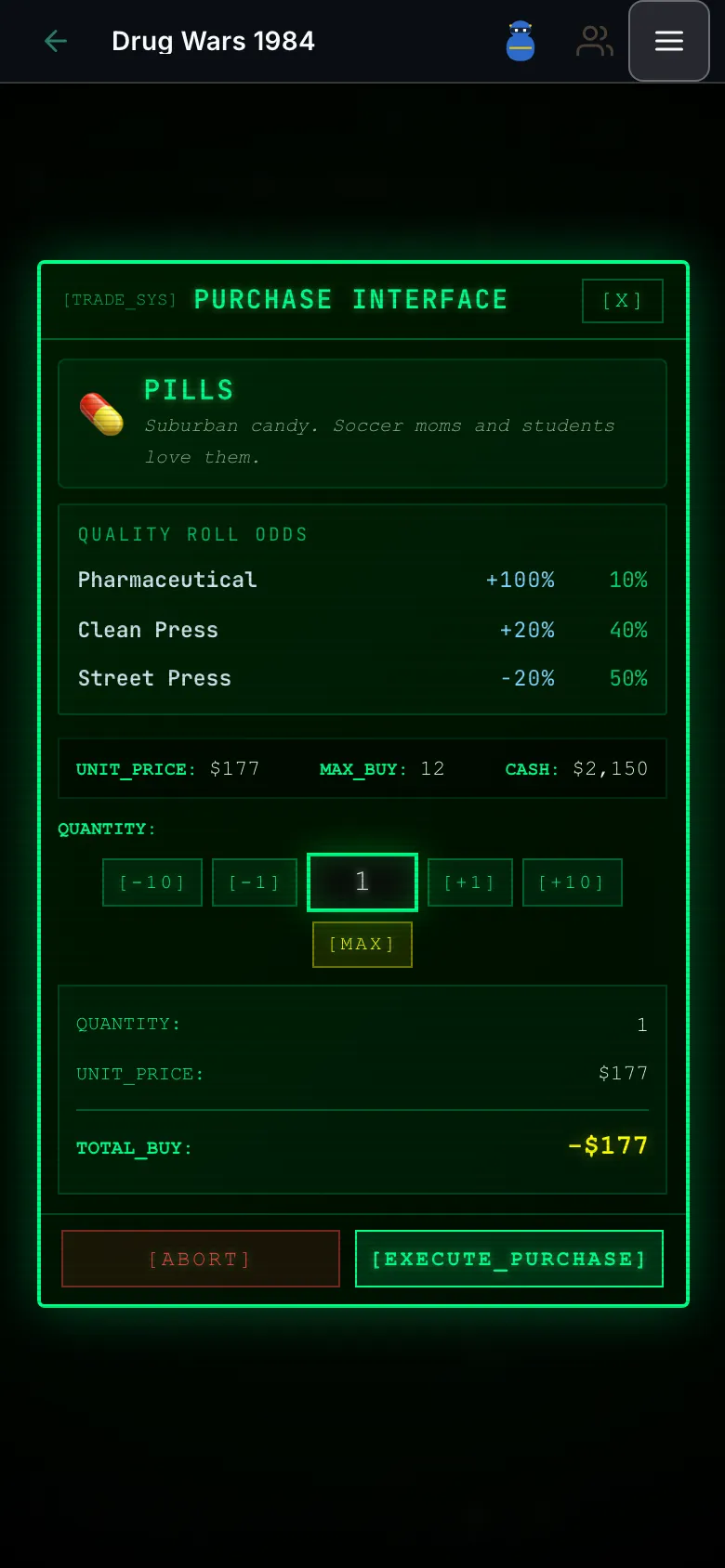
Drug Wars: 1984 on a 390 by 844 phone, one of the screen sizes our browser tests use.
Who are the people inside a persona?
Each kind becomes three fictional people with different temperaments. Each person is scored on the six HEXACO traits, from 0 to 1: honesty-humility (H), emotionality (E), extraversion (X), agreeableness (A), conscientiousness (C) and openness to experience (O) [13]. Each also gets a circumstance, such as where and when they play or what they fear losing. The Dope Wars veteran's three simulated people:
| Person | H | E | X | A | C | O | Circumstance |
|---|---|---|---|---|---|---|---|
| Dana, a bookkeeper | 0.65 | 0.35 | 0.30 | 0.40 | 0.85 | 0.30 | Plays on a laptop over lunch; checks the cash, the debt and the six drug names before pressing anything |
| Marcus, a line cook | 0.45 | 0.30 | 0.70 | 0.55 | 0.25 | 0.85 | Taps a friend's link at a bus stop, skips every line of text and wants to see what is new |
| Jen, a night-shift nurse | 0.70 | 0.80 | 0.35 | 0.60 | 0.55 | 0.45 | Plays in bed with a podcast on; lost two years of high scores to an app update and fears a wipe-out on day two |
No real reviewer is portrayed. Jen's fear has a real source. An App Store reviewer of another remake wrote: "2 days in and I've been either killed by the loan shark or the cops." [14]
How does a persona play?
A model plays each person in the first person, on the live game in a real browser at 1440 by 900 with sound on, through what the screen shows. It writes a diary as it plays: what it expected when it pressed PLAY, what the game taught and what it had to guess, when it felt clever or cheated, its first moment of delight and the action, if any, where it would have closed the tab. At the end each person scores fun and difficulty out of 10 and says whether they would come back, tell a friend or pay. Each person's notes are marked as simulated play.
The next three kinds, the tactics and fight player, the role-playing and dice-check player and the survival and base crafter, will play a checklist that touches every system of the game. They will score each system for fun and say at the end of each in-game day whether they would play one more.
Where did two kinds of player disagree?
Two simulated people on the same preset gave the same game opposite verdicts. Marcus, the bold veteran, tripled his money on his first buy-low, sell-high trip on normal and went from $2,150 to $9,891 by 2 PM on day 1. He rated it fun 7 and difficulty 3, and called normal too easy. Priya, the anxious first-time guest, played normal with small, careful stakes and was down to $5 by the afternoon of day 1, against a $50,000 debt. She rated it fun 3 and difficulty 8.
Traits split people inside one kind too. Dana, the conscientious veteran, read every receipt on the hard preset and caught a hidden markup on her first buy. Jen, high in emotionality, played nightmare, read the whole tour, fled every fight and would have left at the first sign that the numbers could not be trusted. HEXACO describes people with very high emotionality scores as people who "experience fear of physical dangers" and "anxiety in response to life's stresses" [13]. Marcus alone would have reported a game that is too easy, and Priya alone a game that is unfair.
What do digital twins add?
We also ran the same five kinds as digital twins in Paracosm, our open-source engine for simulated people with HEXACO personalities. Each twin played a first week of six short visits against a written description of the game, never its screens, at about $1.51 and 8 minutes a person. All five finished, and none quit: intent to come back started at 60 out of 100 and ended between 51.9 and 63.9. Our write-up on the AgentOS blog has the code, two twins' weeks visit by visit and the cost.
The twins and the browser plays agree that the debt hurts most and that the first trade is the first pleasure. They differ on leaving: each kind's careful first person in the browser reached a moment where they would have closed the tab, and no twin did. No twin built any money either, while the careful browser guest paid off the debt by day 3. Twins follow a week of returns and give a reason for every choice. Only the browser plays see the real screens, prices and crashes, such as that hidden markup. All five twins carried the careful person's profile, so the impatient and anxious people who found the exploits and left soonest had no twin in this run.
What can a persona not tell you?
A persona's report is a model's guess. It orders the questions we ask, and a real player's word outranks it.
What does an AI playtest check on every turn?
Six rule checks run after every move, reading the state before and after the move and the narrator's text:
| Check | What it flags |
|---|---|
| Health | A swing of 50 HP or more in one turn when the narration has no damage or healing words |
| Items | An item count that jumps with no reason in the prose |
| Content limits | A breach of the game's content limits |
| Continuity | The narrator mentioning dead characters or destroyed places |
| Session health | A turn with empty narration or a recorded time of 0 ms |
| Narration text | Doubled or cut-off words |
We label the health check "moderate", because poetic combat prose can trip it. An optional judge mode scores every narrator turn from 0 to 100 on continuity, agreement with the game state, character voice and whether the player's action was acknowledged. Each run also counts the scenes, items, endings and cast members it reached.
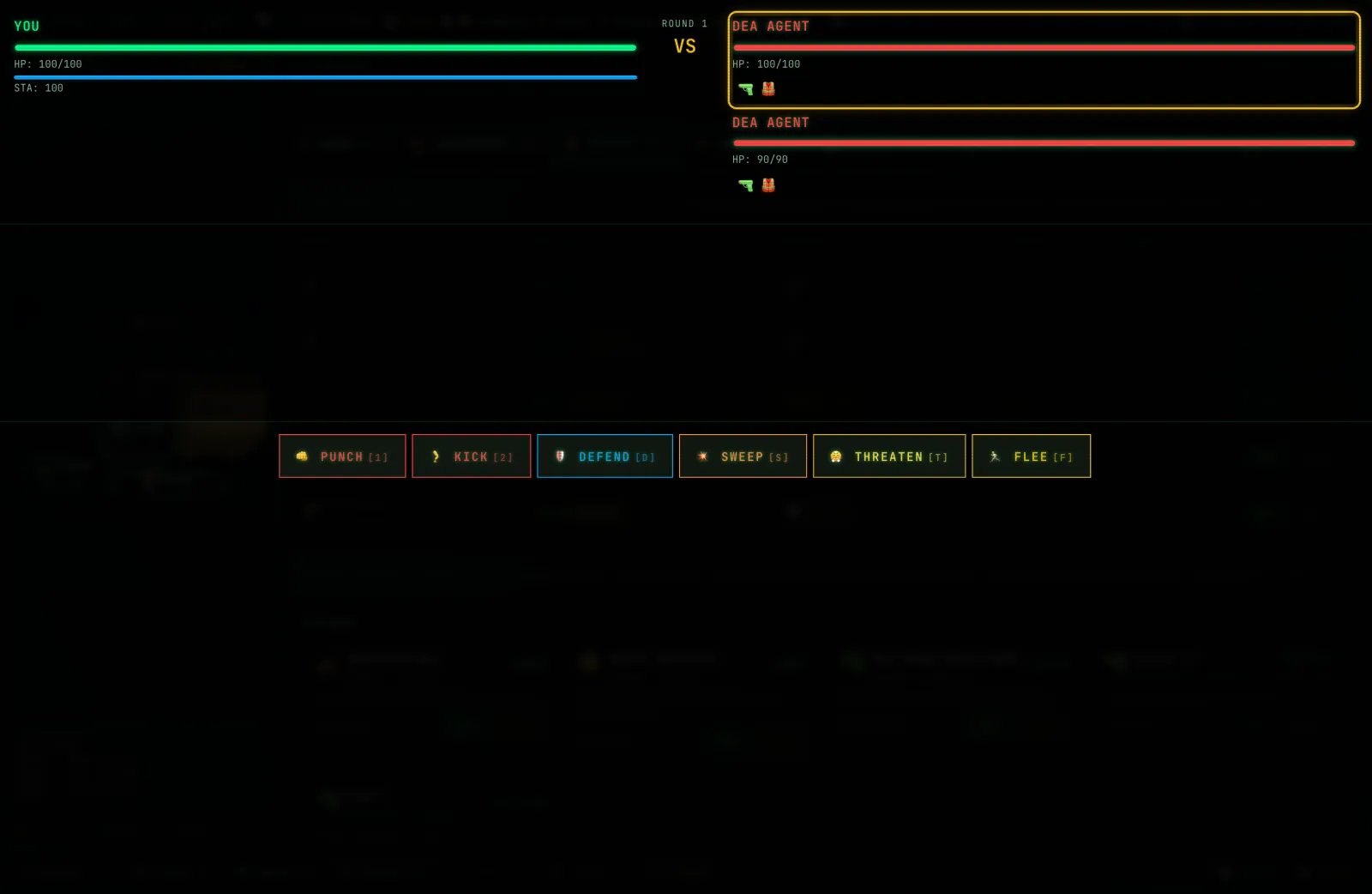
Round 1 of the first fight, the player at 100 of 100 health: the kind of number the health check reads from a game's state.
Why do we also playtest in a real browser?
The API playtester never sees the screen, so it misses console errors, stuck transcripts and broken layouts. A classic text adventure threw "npcVoiceCues is not defined" in the browser on every typed turn, and the API playtester could not see it. We run two kinds of browser test.
In the first, an AI agent follows a written procedure. It plays a published game through its real screens in Chrome, 8 turns by default, and reads the console and network after every turn. It chooses how to play from what it sees, from a typed command box or choice buttons to an emulator canvas or a tactical grid. Findings are graded critical (a page error, a turn that never advances, a blank screen), major (missing images or sounds) or minor (a turn slower than 10 seconds, a layout glitch).
The second is a set of 34 browser test suites that run at each release. Each release builds its own app image and starts it against Postgres 16 loaded with production's schema. Playwright's Chromium [7] then signs in and uses the pages as a person does. Three of these suites, with the screens they use:
| Browser test | Screen | What it plays and checks |
|---|---|---|
| Roguelike run end | Pictures at desktop and phone width | Lets a seeded two-floor run die; the "Run over" card must name floor 1 of 2 and the last enemy to strike, and no ending scene may play |
| Shooter combat | Software WebGL | Holds fire in a seeded first-person shooter; the combat log must read fire, hit, stagger, stop, then "Kills 1" |
| Dungeon touch controls | 390x844 upright, 844x390 on its side | No control or readout may overlap another, and the pause screen must list the touch controls |
A separate visual-novel check, run on changes to the story screen, plays a published story on the live site: 30 turns at 1440 by 900 and 6 at 390 by 844. On every turn the stage must fill at least half the screen height and keep its dialogue box.
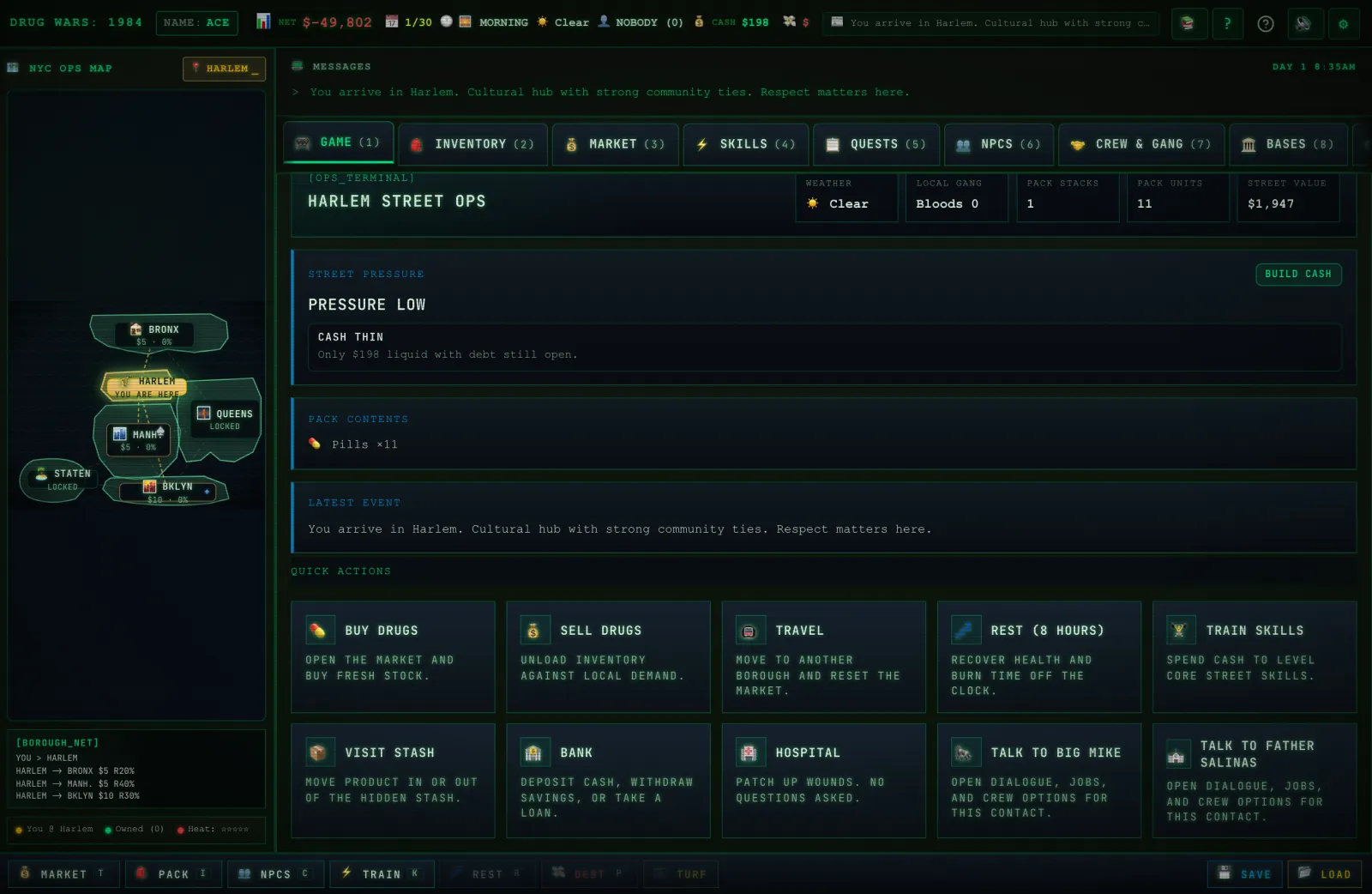
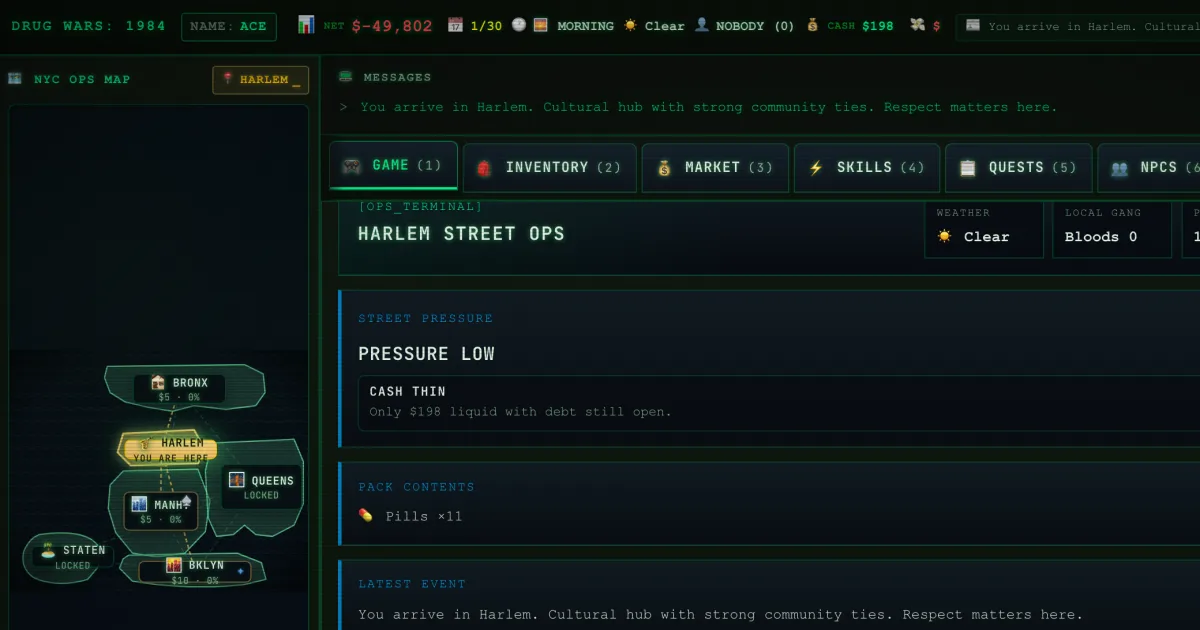
Drug Wars: 1984 after the first trip, on a 1440 by 900 desktop. It is one of four games in our curated sweep.
How are AI-created games tested on wilds.ai?
We test the pipeline that makes them by building new ones. Our test rig creates fresh games in 18 families from written prompts and drives each one in a real browser. AI judges then grade each game from its drive record and screenshots.
A game built last month proves only that it renders. A fresh build shows whether the platform can compile a game, make its art and write its code today. To keep builds fast, test games skip portraits, music, lore, cutscenes and cover art.
Fourteen families are played with keys and clicks: arcade, platformer, roguelike, six kinds of 3D game, board game, survival, strategy sim, incremental and racing. Four are told by an AI narrator: narrative, tabletop RPG, visual novel and crawler. The arcade family's prompt asks for "A fast twin-stick arcade space shooter". Its input recipe presses ArrowUp, ArrowRight, Space, Space, ArrowLeft, Space for 400 ms each, then expects the HUD to show score, wave and lives.
The drive waits up to 180 seconds for a game to load. It records the buttons pressed, the keys held, the on-screen text, numbered screenshots with how much each frame changed, errors and a WebGL probe. Keys go in as trusted browser input to a focused canvas, because game engines ignore scripted key events. The drive leaves each game idle for 8 seconds and compares frames, and a realtime game whose idle frames never change fails "animated". It never presses Retry or Rebuild on a failed build, because the failure card is the evidence.
A chain of agents judges the results. Each game gets one judge, which grades only the dimensions its family has. There are twelve in all, from graphics and controls to scene match and winnability. A triage agent groups defects across games by shared cause. For each serious group, from P0 (the game cannot be played) to P2 (a defect a player will notice), a verifier tries to refute it against the source code. When the evidence does not hold up, the verdict is refuted. That guards against a failure other developers report: one on Hacker News wrote of occasionally getting "I tested it and it works perfectly!" while the player sat stuck halfway into a planet [8].
Judges are told what the harness itself causes, such as a software GPU on a busy machine, so those effects are marked as test artifacts. A confirmed fix must change the system that made the defect, never one game's data. Test games stay private, and each run ends in a PDF report with every game's grades, three to six captioned screenshots and its findings. Separately, our screenshot tool uses a picture as a game's featured screenshot only after a model judges it "ok".
What does a full AI playtest loop look like?
Here is one game through the whole loop, from 15 to 18 November 2026. Drug Wars: 1984 is our curated trading game: the player has 30 in-game days in 1984 New York to pay off a $50,000 debt to a loan shark. Steps 1 to 6 ran on this game; where a step led to a fix, it says whether that fix is live, merged or still open. Step 7 is planned.
1. Who plays this genre?
Five kinds of gamer, three people each, researched from public quotes before any play, as the persona section above describes. On 17 November we researched three more kinds for the systems the game is growing: the tactics and fight player, the role-playing and dice-check player, and the survival and base crafter.
2. How does a driver play the live game?
A driver script plays the production site in headless Chromium through Playwright [7]. It presses what a player presses and reads the game's real state from the page's own store, so every press is logged with the day, cash, debt, health and heat, and the sounds it started. For setup, such as a difficulty preset or moving the clock to the last day, it uses the game's own actions. It takes pictures at pivotal moments: the first sight of each window, each fight, each event, each ending and each error screen.
It also keeps tests out of the live numbers. Every session it opens carries a test mark, and in each of the 27 runs that checked, the server had stored it as a test session. The game's page read 195 plays and 82 players before 56 test sessions and the same after them. It answers the game's score submission itself, so a test run never reaches a public leaderboard, and it refuses any site control that would sign out, delete, publish or make a purchase.
The persona plays run on this driver. So do five scripted players: a min-maxer that trades only on prices it has seen on screen, a speedrunner that rests its way to the ending, a pacifist that flees every fight, a chaos player that presses random controls, and a fuzzer that types values such as 0, -500, 12.5 and 1e9 into the game's amount fields.
3. What did the plays find?
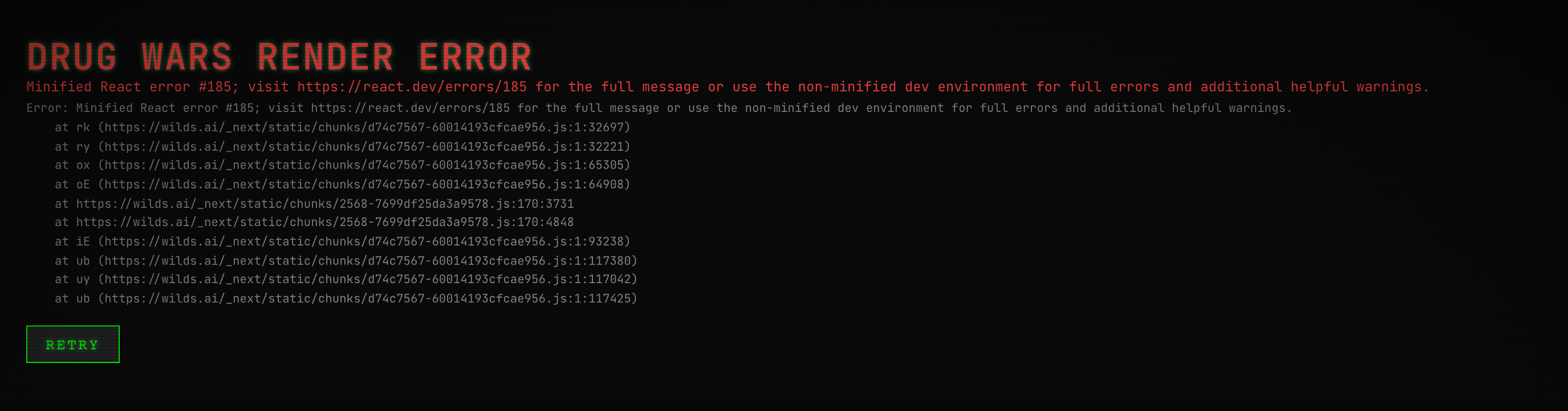
Before the fix: what a player saw when the 30 days ran out, captured by the driver on 16 November. RETRY and a page reload both came back to this screen.
- An error screen at the ending and in fights. When the 30 days ran out, the game fell to its error screen instead of the GAME OVER panel, so a player who survived never saw an ending or a score. The same screen came during and at the end of fights, on the first arrival in Staten Island and on a sale that ended the game. Six of nine early driver runs met it.
- No music for new players. Two walks of the first minutes logged 260 sound effects and no music, because music was off until a player turned it on.
- A placeholder for the player's name. The busted ending printed "Big Tony Torrino tells the papers he hardly knew [NAME]." The ending text never went through the step that puts the player's name in.
- A hidden price on the harder presets. The buy window showed one price and the game charged another. On hard, Dana, the careful veteran, was offered 6 pills at $177 each; the game showed "Bought" while its log said "You can't afford 6x Pills ($1,272)". On a check of the live site on 18 November, before the fix went live, one unit of weed showed $698 on the ticket and took $838 from cash, a 20% markup the screen never mentioned.
The error screen had one cause. Its own stack trace named the function that shows the game's pop-up notices, and that led to a loop. The screen shows each pending city event as a notice and then asks the engine to clear the queue. The engine refused every request after game over, and every request but a fight move or the end of the fight during a fight, so the queue stayed full. Each refused request still returned a fresh copy of the game state. The screen took the same events for new ones, showed them again and asked again, until React stopped it with its maximum update depth error.
The fix has two parts. The engine clears the queue at any time, and the screen matches events by their content, shows each one once and asks again only when something new arrives. The tests rest the real dashboard into day 31 on the real engine, and they failed on the old code. The crash and music fixes went live on 17 November and the name fix later that day. The buy fix, which makes the ticket quote what the game charges, went live on 18 November.
4. How fun did the simulated players find it?
Fifteen simulated people played the live game, three of each kind. The driver applied easy, hard or nightmare to 9 of them through the game's own action, and the other 6 played normal. "Left at" is the action where that person would have closed the tab; fun and difficulty are out of 10, as the simulated person felt them.
| Kind | Person | Preset | Fun | Difficulty | Left at action | Come back? |
|---|---|---|---|---|---|---|
| First-time guest | Dana, careful | normal | 5 | 4 | 96 | Maybe once |
| First-time guest | Marcus, impatient | easy | 3 | 1 | 28 to 30, after a crash | No |
| First-time guest | Priya, anxious | normal | 3 | 8 | 58 | No |
| Dope Wars veteran | Dana, careful | hard | 2 | 9 | 78 | No |
| Dope Wars veteran | Marcus, bold | normal | 7 | 3 | Did not leave | Yes |
| Dope Wars veteran | Jen, anxious | nightmare | 1 | 10 | 30 | No |
| Sim and tycoon optimizer | Marcus, careful | nightmare | 3 | 10 | 75 | Once, on normal |
| Sim and tycoon optimizer | Dee, explorer | hard | 6 | 7 | 46 | Maybe |
| Sim and tycoon optimizer | Rosa, anxious | normal | 4 | 8 | 30 | Only if one ambush cannot end a run |
| Run-game player | Priya, careful | hard | 4 | 9 | 71 | Only for the Records board |
| Run-game player | Jaden, impatient | nightmare | 5 | 10 | 25 | Maybe |
| Run-game player | Marisol, anxious | normal | 4 | 7 | 49 | No, unless saving works |
| Casual phone sim player | Dana, careful | easy | 5 | 7 | 135 | Maybe once |
| Casual phone sim player | Marcus, impatient | normal | 4 | 6 | 24 | No |
| Casual phone sim player | Renee, anxious | easy | 3 | 7 | 55 | No |
Fun averaged 3.9 out of 10, and 14 of the 15 reached a moment where they would have left. These are simulated players. Three of them played before the crash and music fixes went live at 05:31 UTC on 17 November, two played across that release and ten started after it. All fifteen played before the fixes to the ending's name and the buy price. The scores order our questions; whether Drug Wars: 1984 is fun stays a question its real players answer.
5. How do findings become changes?
Each kind's notes end with the ten changes that would help that player most, in order, each tagged fix, tune or new feature. Findings that several kinds share rank first. Three were met by all five kinds: a debt whose rate, growth and part payment the game never shows, screens that disagree about the debt and the prices, and early fights that can end a run on day 1.
Next comes an audit for each system. An audit reads the code at a named commit and lists every mechanic: what it is in a player's words, where it lives, whether a player can reach it, whether it works, what the simulated players met, and what the best and weakest games in the field do with it. Every failing input is traced by reading the code. Four audits ran on 17 and 18 November. "Broken" counts the mechanics each audit lists as failing on a named input, as dead code, or as doing nothing when reached:
| Audit | Mechanics | A player can reach | Broken |
|---|---|---|---|
| Fights and loot | 50 | 43 | 12 |
| Quests and the story's people | 35 | 28 | 22 |
| The market | 54 | 46 | 31 |
| Pack, gear and merchants | 56 | 47 | 34 |
The fights audit found why the escape hurt so much. FLEE succeeds 10 to 37% of the time across the game's 41 fights, the odds are never shown, and a failed flee hands the enemies two turns instead of one. Dana and Jen, two of the veterans, each lost 56 HP to a single failed FLEE press. Its fix, which gives the enemies one turn a press, went live on 18 November. It changes the strategy-sim engine that every game of that family shares, and it came with a test that failed on the old code.
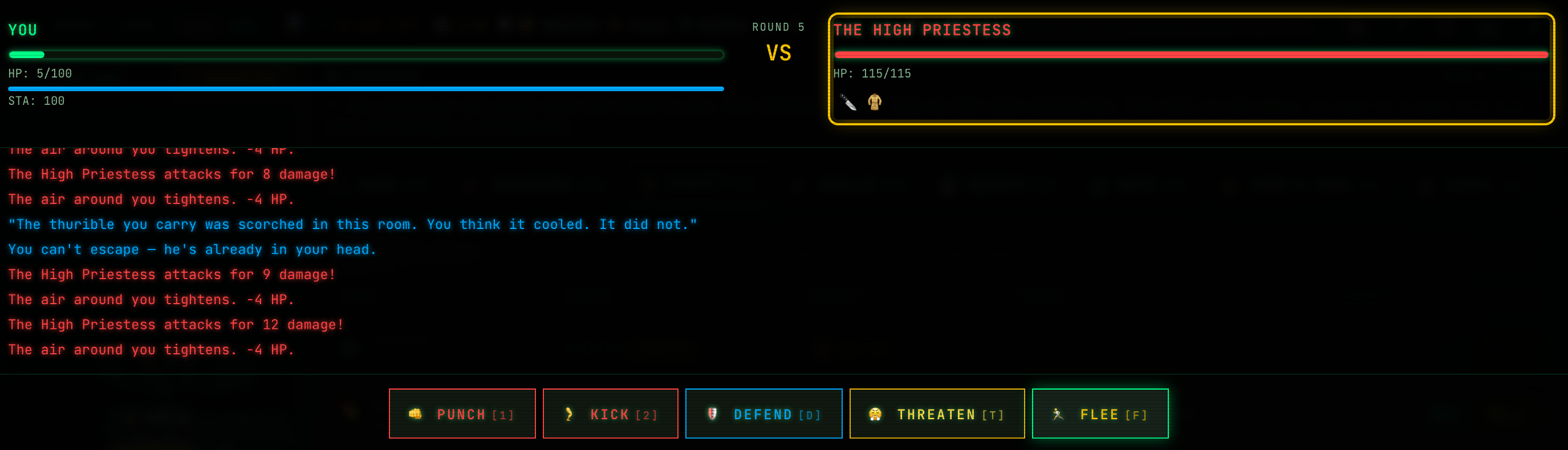
Rosa, the anxious optimizer (simulated), on her first trip to Manhattan on day 1. After one locked FLEE press ("You can't escape"), the log shows two attacks and two -4 HP ticks: two enemy turns for one press.
The quests audit found the first job nobody could take. Tony's first job, Welcome to New York, reads ACTIVE in the Quests tab from day 1. Talk to him and the only answers are JUST TALKING and LEAVE: the line about the job waits for a switch in the game state that nothing sets, so the screen hides it. Four of the five kinds met that dead end.
The same audit corrected an earlier count. A first read of the engine had found 32 of 37 quests with no way in. The audit read the code again and found that the 11 contacts' jobs can be taken by asking "Got any work?" and answering "I'm in", and three simulated players had done it. The right count is 25 of the 37 jobs that cannot be started and 12 that are started or can be, and none can be finished. The audits re-read the counts made before them, and this one corrected a count that an earlier decision had used. Fixes for the jobs are queued, and each will go out as a pull request of its own.
Questions of taste have no failing input, so they go to a board. It has seven seats: a game designer, a players' seat that speaks for eight personas, a combat designer, an economy designer, the tech lead of the shared strategy-sim engine, a storyteller and a devil's advocate. Each seat answers separately, on three engines from different model makers. A refuter then attacks each seat's answer, a chair writes the decisions, and a separate check compares the chair's memo with the seats. On 17 November all seven refuters returned "confirmed with change", and the check found no mismatch. One decision answers the debt finding: a DEBT key that shows the next charge and the day it falls due, and takes any amount. It is decided and planned; it is not built.
Fixes with a failing input go out as small pull requests, each carrying tests that fail on the old code. On the buy fix, 57 new tests failed on a commit that held only the tests. Changes are then read cold by a second engine, from another model maker. On the buy fix it found three P1 and five P2 defects, each with a failing input, and a fixer of their own is queued for them.
6. Did the fix work on the live site?
After a fix goes live, the driver replays its path on production. On 17 November, once the crash and music fixes were live, it moved the clock to day 30 with the game's own rest action, closed each day's windows through the screen and pressed the last rest itself. The day-31 report opened, then the GAME OVER panel, with no error screen and no console error. A walk of the first minutes that day logged the night-city music starting as a loop at the intro logo. After the name fix went live later that day, the same replay ended on "he hardly knew Ace", the street name the driver typed. On 18 November, after the buy fix went live, it repeated the hard-preset buy from step 3. The ticket for one unit of weed read $838, and $838 left the player's cash. The market list beside it still read $698, the price before the hard preset's markup, so the replay itself found the next thing to fix.
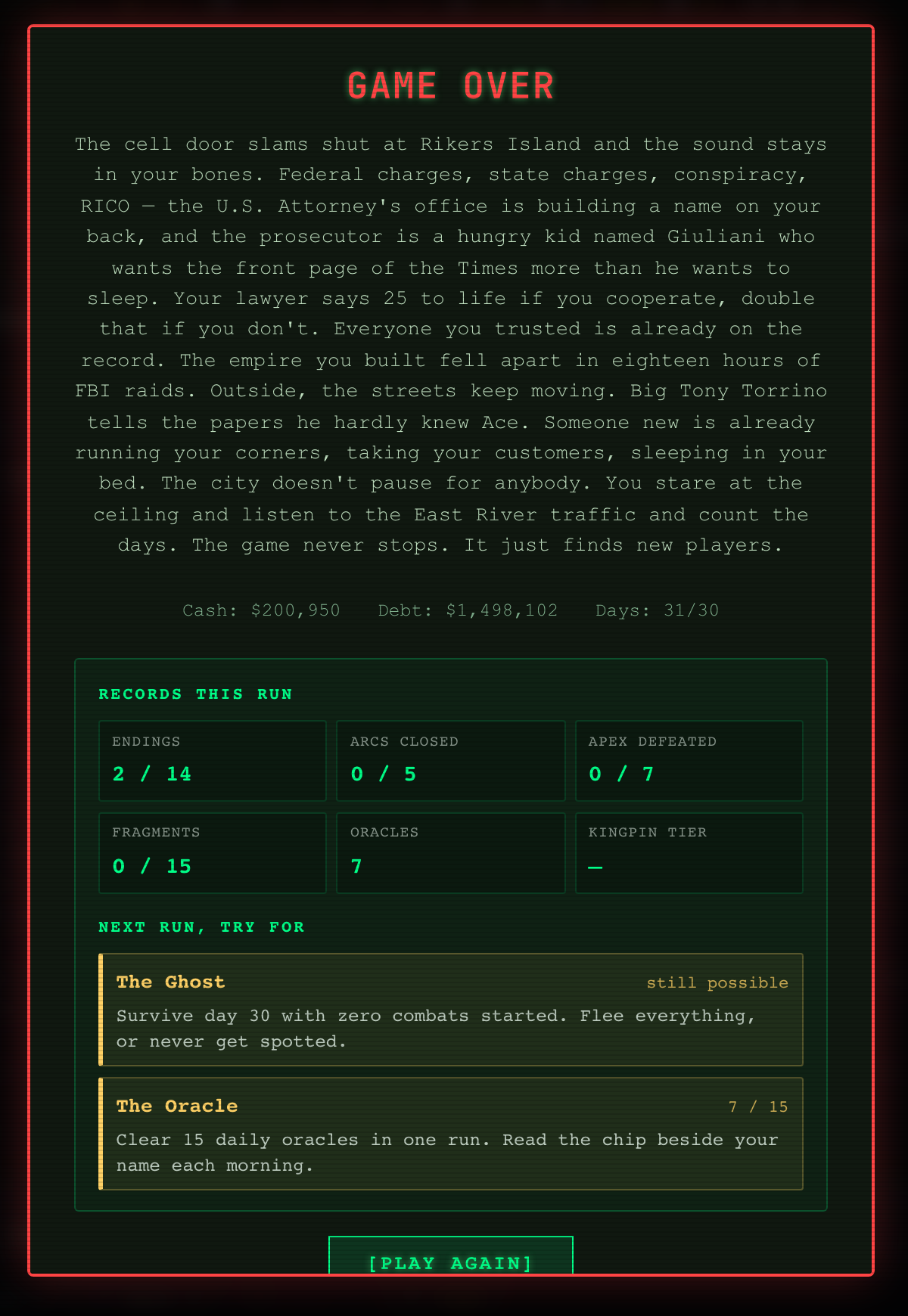
After the fixes: the GAME OVER panel on the live site on 17 November, reached by the same replay that met the error screen on 16 November.
7. What comes next?
The same loop will run on every game on wilds.ai, started when the team chooses: on our own games, and on games other people made. Every game will get a scorecard, and a game someone else made will be changed only where its creator has opted in. This is planned and not built.
What defects have our playtests caught?
Our playtests have caught games that could not be finished, a play page that lost its place in long stories, and phone controls covered by readouts.
Trading sims that could never end
An agent drove an AI-created trading sim for 45 trips and 302 actions, and the calendar read day 1 of 30 at the end. Each trip added its own travel time, 30 minutes when the compiler wrote none, so a 30-day season of 1,440-minute days needed about 1,440 trips. The fix on master, in the shared engine that strategy sims run on, makes each trip take at least a quarter of a day: about 120 trips a season.
A long story that showed turn 25 at turn 100
A 100-turn test run on 4 November 2026 reopened a story at turns 50, 75 and 100. Each time the top bar showed "Turn 25" and the page opened on the oldest of the 50 messages it had loaded. The play page loaded the newest 50 messages and read both the turn number and the opening position from those 50. A browser suite on master opens a seeded 60-turn story and checks both.
Readouts drawn over the touch stick
An audit on a 390 by 844 phone on 12 November 2026 found a dungeon game's generated health and coin readouts drawn over its touch stick. A minimap filled the top right of the view, and the pause screen listed keyboard keys. A browser suite on master opens the game upright and on its side, measures every control and readout and holds them apart, and checks that the pause screen lists the touch controls.
What can't AI playtesting tell you?
AI playtesting cannot tell you whether a game is fun, and it cannot hear. It shows where a game breaks, stalls or cannot be finished, and people judge the rest. vgm.co describes itself as "market & user research for the video game industry". Its answer to "Can AI playtesting replace human playtesting?" is "No." [9]
- Persona play is simulated. What a persona reports is a model's guess, never a player's word.
- Sound needs a person listening.
- The checks are heuristics. When the judge model errors or times out, that turn counts as a pass with the error attached.
- Short drives rarely reach an ending. Our deeper verdicts come from longer plays that people read.
- The rig cannot judge speed. It draws with a software GPU on a busy workstation, so its frame rates measure the machine.
- Test builds are lean. Portraits, music, lore, cutscenes and cover art go untested in the rig.
- Multiplayer has no automated track.
- Vision models miss fine detail. A Sony benchmark of 16 vision-language models found they "continue to struggle with fine-grained visual details, subtle regressions" [10].
Play a game on wilds.ai
Pick a game from the world library and play your first session: browse games on wilds.ai.
Related: How wilds.ai NPCs and Characters Actually Remember You | The Asset Forge | How to Build Your First World | AI-created games in the help center
Sources
- "How common are automated tests in the gaming industry, beyond just unit tests?": r/gamedev thread, 10 March 2026.
- Dylan Scandinaro, "Automate your playtesting: Create virtual players for game simulation": Unity blog, 11 December 2020.
- Holmgård, Green, Liapis and Togelius, "Automated Playtesting with Procedural Personas through MCTS with Evolved Heuristics": arXiv 1802.06881, 19 February 2018.
- Google Cloud on Capcom's AI agents for playtesting: Google Cloud press page, 22 April 2026.
- Alexander Andelkovic on BAIT, King's bot for testing Candy Crush Saga: InfoQ, 30 December 2019.
- Wang et al., "Leveraging LLM Agents for Automated Video Game Testing": arXiv 2509.22170, 26 September 2025.
- Playwright: documentation, read 16 November 2026.
- "Letting AI play my game – building an agentic test harness to help play-testing": Hacker News discussion, 29 April 2026.
- "What AI Playtesting Can and Can't Do (And Where Real Players Still Win)": vgm.co, 25 July 2026.
- VideoGameQA-Bench, a benchmark of vision-language models for game QA: Sony Interactive Entertainment, 23 December 2025.
- Steam discussion on Schedule I, a player who "played the crap out of DopeWars back in the day": Steam Community, 12 April 2025.
- Hacker News comment on "Drugwars for the TI-82/83/83 Calculators (2011)": Hacker News, 20 March 2026.
- Kibeom Lee and Michael C. Ashton, HEXACO-PI-R scale descriptions: HEXACO.org, read 18 November 2026.
- App Store customer reviews of Dope Wars: Mobile: Apple's public review feed, review of 23 May 2026.